




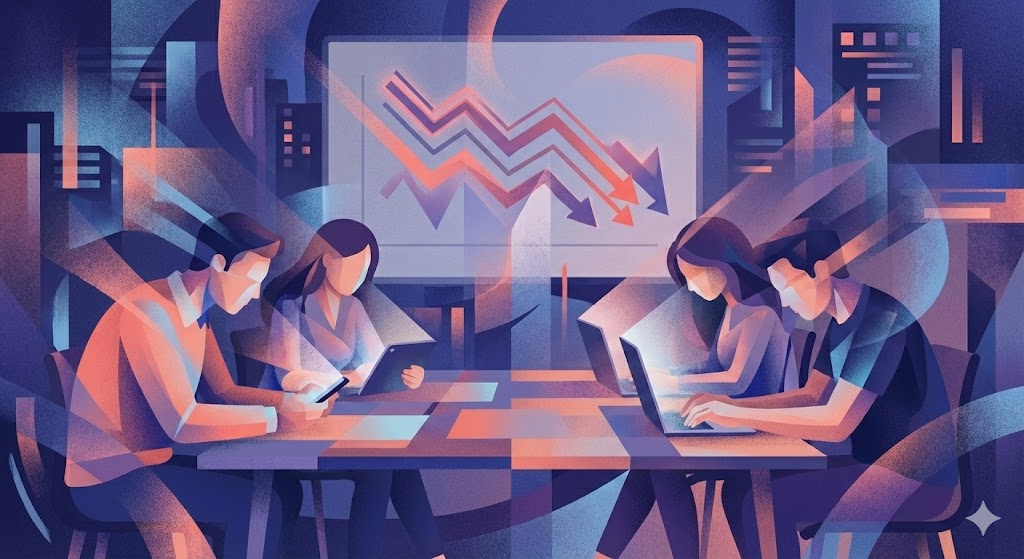
IQ scores in the U.S. have been dropping since 2006. Not a little—consistently, across multiple cognitive domains. For the first time in nearly a century, we’re measuring lower in logic, vocabulary, and computational abilities. And if you run a tech company, this isn’t just a curiosity. It’s your hiring pool.
The Reverse Flynn Effect
For most of the 20th century, IQ scores rose steadily. Each generation tested smarter than the last—a phenomenon called the Flynn Effect. It seemed inevitable. Progress marched forward.
Then something changed.
Between 2006 and 2018, American adults started scoring lower on tests measuring verbal reasoning, logic, and mathematical ability. The only area that improved? Spatial reasoning—the kind of visual problem-solving you do when navigating apps or playing video games.
We’re not getting dumber across the board. We’re getting dumber in exactly the skills that matter most for building companies.
The Hiring Pool Problem
A few months ago, I wrote about the graduate skill gap in Palestine—how universities produce thousands of IT graduates who can’t code, can’t problem-solve, can’t think critically. I blamed the education system.
I was half right.
This isn’t just a local problem. It’s not even just a university problem. The cognitive abilities tech companies need most—analytical thinking, complex problem-solving, sustained focus—are declining across entire populations.
We’re hiring from a pool that’s measurably worse at the exact things we need them to do. And it’s not because they’re lazy or unmotivated. It’s because their brains have been trained to work differently.
The generation entering the workforce grew up with smartphones, constant notifications, and infinite feeds designed to hijack attention. They’re excellent at visual processing and multitasking. They’re struggling with deep, linear thinking.
What’s Causing This?
The research points to what some scientists are calling “brain rot”—the cognitive effects of constant digital stimulation.
Here’s what happens: your brain gets overstimulated switching between tasks. Slack notifications, email, Twitter, news feeds, text messages. Each one pulls focus for a few seconds. Your brain never gets a chance to settle into deep work.
Over time, this rewires how you think. Sustained attention becomes harder. Complex problem-solving feels exhausting. You reach for your phone when you hit a difficult problem instead of pushing through it.
We’ve outsourced memory to our phones. Outsourced calculation to computers. Outsourced navigation to GPS. And in doing so, we’ve atrophied the cognitive muscles we need to build hard things.
The Founder’s Dilemma
Here’s what makes this hard to see: you’re swimming in the same water.
You’re worried about your team’s productivity, but when’s the last time you had three uninterrupted hours to think deeply about your business? No notifications, no Slack, no “quick questions.”
I can’t remember the last time I did.
I context-switch constantly. Email to code review to Slack to Twitter to a customer call back to email. Every switch costs cognitive energy. By the end of the day, I’m exhausted but haven’t done any real thinking.
And if I’m doing this—someone who’s been in tech for 26 years and should know better—what about the junior developer who’s never known anything else?
What This Means for Building Companies
You can’t just blame “bad graduates” anymore. This is systemic. It’s affecting everyone, including you.
The competitive advantage might not be who has the smartest team. It might be who protects their team’s cognitive capacity best.
Think about it: you hire smart people for their ability to solve hard problems. Then you put them in an environment designed to prevent deep thinking. Always-on culture. Slack channels that expect instant responses. Meetings that fragment the day into 30-minute chunks.
You’re paying for deep work and optimizing for shallow work.
Your notification culture is killing the exact cognitive abilities you hired for.
No Easy Answers
I don’t have a solution here. I’m still figuring this out myself.
But I’m starting to think about how I structure my day differently. Longer blocks without interruptions. Turning off Slack for half the day. Saying no to meetings that could be async updates.
And I’m thinking about my team’s environment. Whether “always available” is actually helping us build better products, or just making us worse at thinking.
Maybe the next competitive moat isn’t better technology or faster shipping. Maybe it’s better attention. The ability to think deeply about hard problems while everyone else is refreshing Twitter.
If IQ scores keep dropping, the companies that win might just be the ones that figured out how to stop making their teams dumber.
Sources: Northwestern University study (2006-2018), NIH research on digital cognitive effects, and my own exhausting experience trying to think while my phone buzzes every 90 seconds.